Why probabilities beat point forecasts
Single-price forecasts can be misleading. A model can be directionally correct while missing magnitude, or land close to the close while being wrong about risk. Instead of asking for the exact next candle, I asked a more useful question: where is SPX likely to end up after the next seven hourly candles, and with what probability?
What I built
The model outputs a probability distribution over the next-day move. That lets me compute trading-style probabilities like:
- P(Δ7 ≥ +10 points)
- P(Δ7 ≤ -10 points)
- P(|Δ7| ≤ 10 points)
This framing matches how traders think: ranges, probabilities, and risk bands rather than a single deterministic close.
Dataset
I used hourly SPX OHLC candles. Each row is one hour of open, high, low, and close. The model looks back 120 hours (about 3-4 weeks of trading hours) and predicts the move over the next 7 hourly candles, which is one full trading day. Training data spans May 15, 2019 at 10:30 AM ET through January 23, 2026 at 3:30 PM ET.
Turning forecasting into classification
Instead of predicting a future close, I predict the future point move after seven hours and discretize it into bins.
Future move
Δ7 = Closet+7 - Closet
BIN_SIZE = 5 | MAX_MOVE = 200
Each label is a single bin index. The CNN then outputs an 80-bin softmax distribution for the next-day move.
Windowing setup
WINDOW = 120, HORIZON = 7. Each input is a 120-hour feature matrix.
Shapes
X ∈ R120 x F
y ∈ {0, 1, ..., 79}
Model architecture: fast ResNet-style Conv1D
A small ResNet-style CNN gave the best balance of accuracy, speed, and stability. It is parameter-efficient and trains quickly on hourly candles.
- Stem: Conv1D(32, k=5) + BN + LeakyReLU + SpatialDropout
- Residual blocks: 2x ResBlock(32) → MaxPool → 2x ResBlock(64) → MaxPool → ResBlock(128)
- Head: GlobalAvgPool → Dense(64) → Dense(80, softmax)
Training details
- Time split: first 80% train, last 20% test.
- StandardScaler fit on training only.
- Batch size 1024, epochs 20 with early stopping.
- Loss: sparse categorical cross entropy.
- Optimizer: Adam (lr = 1e-3).
- Callbacks: EarlyStopping(patience=4), ReduceLROnPlateau(patience=2).
Probability map outputs
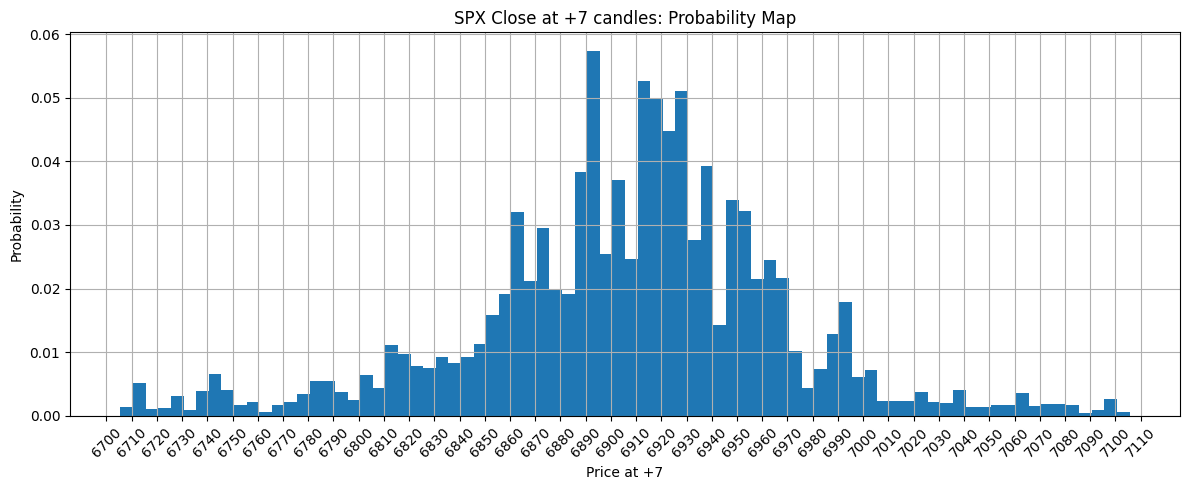
The output is a full histogram of likely Δ7 outcomes. From that histogram I compute bullish, bearish, and chop-day probabilities. The histogram below reflects the latest available data as of January 23, 2026 at 3:30 PM ET.
CNN vs Transformer results
I tested a Transformer model on the same task. It consistently lagged the CNN on short-horizon errors.
CNN errors
Step +1 RMSE: 23.0
Step +5 RMSE: 51.0
Transformer errors
Step +1 RMSE: 24.0
Step +5 RMSE: 53.2
Why CNNs won on this dataset
- CNNs assume local, reusable patterns, which matches candle behavior.
- Transformers need more data to learn locality from scratch.
- CNNs trained faster, so iteration and tuning were more productive.
Automating the pipeline (next step)
- Append new hourly candles to the dataset.
- Fine-tune the model on CPU for a few epochs.
- Generate the next-day probability map.
- Publish the histogram and JSON to the site.
Final takeaways
- Predict distributions, not point estimates.
- Small CNNs can outperform larger models on realistic datasets.
- Probability outputs align better with trading decisions.
Sources
This post is educational only. Trading decisions should be made with professional advice and your own risk controls.